From negative cash flow to sustainable growth through operational finance leadership
If you're a doors & windows business owner who feels like your revenue never quite turns into cash in the bank, this case study might sound uncomfortably familiar.
A mid-market doors and windows distributor from Victoria, came to us convinced they had a sales problem. Revenue was ticking along, the construction and renovation market was healthy, but cash was always tight and profitability was unpredictable. What we found told a very different story and the turnaround that followed is a great example of what proper operational finance leadership can do.
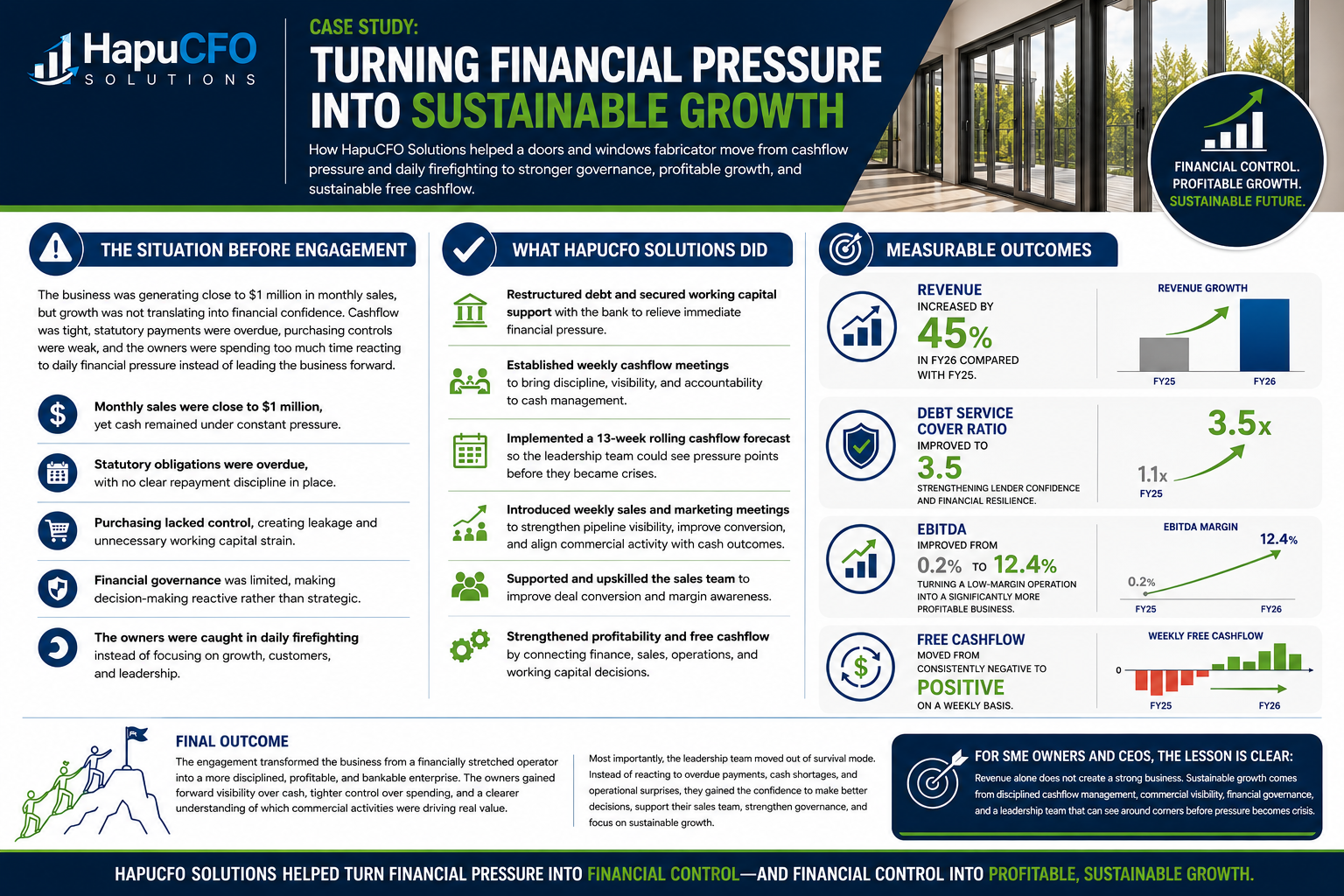
The results at a glance
revenue growth within the engagement period
EBITDA expansion
$500K → $1.4M
Monthly sales run rate
pipeline-to-close conversion rate
The situation
This business wasn’t short on demand. Trade was steady, the market was strong, and on paper things looked fine. But underneath, cash was consistently tight, margins were unpredictable, and leadership had no real confidence in where growth was heading.
Their first instinct like a lot of business owners in this position, was to assume it was a sales problem. Chase more revenue, and the cash issues would sort themselves out.
A proper financial and operational review told a different story. The business wasn’t suffering from a lack of demand. It was suffering from inefficient operations that stopped good revenue from converting into profit and cash in the bank.
What the diagnostic uncovered
A deep dive into the numbers and the day-to-day operations flagged several structural issues:
- Monthly sales sitting below $500,000, with no reliable pipeline to support predictable growth
- Inconsistent CRM adoption, which meant poor visibility into opportunities and patchy sales accountability
- Gross margins swinging wildly across different product categories
- Slow inventory turnover, tying up working capital that should have been fuelling growth
- Reactive procurement, rather than decisions driven by actual demand
- Finance, sales and operations all making decisions in their own silos, with no one joining the dots
The net effect was a business that kept generating sales while quietly bleeding cash month after month.
Our three-pillar approach
Rather than treating this as a reporting exercise, the engagement focused on embedding finance into the business’s everyday operational decisions. The turnaround was built around three pillars.
Pillar 1: Working capital reset
The first job was to stop the cash leakage and get liquidity back under control.
Key initiatives included:
- Implementing SKU-level inventory segmentation using A/B/C classifications
- Clearing slow-moving stock through targeted clearance strategies and renegotiated supplier terms
- Introducing purchase order controls tied directly to sales forecasts
- Aligning supplier payment terms with customer collection cycles
Outcome: The cash conversion cycle improved almost immediately, liquidity stabilised, and a significant amount of working capital that had been locked up in excess inventory was freed up
Pillar 2: Profitability visibility and pricing discipline
Revenue was masking real
profitability problems. For the first time, management could see exactly which
products and categories were actually making money — and which weren’t.
Key initiatives
included:
● Building product-level
profitability reporting
● Identifying low-margin
“revenue traps” lines that
- boosted sales figures while quietly eroding EBITDA
● Recalibrating pricing based on
landed costs and service complexity
● Redesigning sales incentives to
reward profitable growth, not just volume
● Refreshing the go-to-market
approach and tightening up CRM discipline
Outcome: A stronger, better-qualified sales pipeline emerged, delivering a 45%
conversion rate and lifting monthly sales from around $500,000 to $1.4 million.
Growth stopped being expensive and started being profitable.
Pillar 3: Operational finance integration
The biggest underlying issue was siloed decision-making. Finance was reporting on what had already happened, while operations were making real-time calls with no financial visibility at all.
To fix this:
● Weekly integrated planning meetings were set up between sales, procurement and finance
● A rolling 13-week cash flow forecast became the business’s core management tool
● Demand planning was properly aligned with inventory replenishment
● Executive dashboards were built to track inventory turns, gross margins, fulfilment performance and cash flow
Outcome: Decision-making shifted from constant firefighting to proactive planning, giving leadership real control over growth, cash and profitability.
The core insight
"The business didn't have a cash flow problem in the traditional sense. It had an operational efficiency problem that was manifesting as a cash flow crisis. Once those operational flows were aligned with financial discipline, cash generation became a natural outcome, not a constant struggle."
The results
Within the engagement period, the business delivered measurable improvements across every key financial metric.
Financial performance
- 40% revenue growth — topline revenue increased while maintaining stronger pricing discipline and a healthier sales mix
- 27% EBITDA improvement — profitability expanded through operational efficiency and margin optimisation, not aggressive cost-cutting
- Positive free cash flow — the business moved from persistent cash shortfalls to consistently generating positive free cash flow
Operational performance
- A significant reduction in excess inventory
- An improved cash conversion cycle
- Better use of working capital
- Structured forecasting and performance governance
- Much stronger alignment between finance and operations
Why do Australian SME owners engage a Fractional CFO?
A Fractional CFO does a lot more than produce financial reports. The role is about:
- Turning financial data into practical operational decisions
- Improving cash flow without relying on external funding or debt
- Increasing profitability through disciplined execution, not just cost-cutting
- Building forecasting systems that support confident, sustainable growth
- Putting scalable financial infrastructure in place for the next stage of the business
For a lot of SME and mid-market owners across Australia, this engagement is a good reminder that a “sales problem” isn’t always what it looks like. Sometimes the real issue is sitting in the operational plumbing inventory, pricing, cash conversion, and the gap between what finance sees and what operations does day to day.
Get those aligned, and cash generation stops being a battle and starts being the natural result of running a well-run business.