

Executive case study: revenue diversification and growth strategy
If your business relies heavily on one or two big customers, this case study is worth a read. It shows what can happen when that dependency isn’t addressed and how a clear, structured strategy can turn a fragile business into a resilient, scalable one.
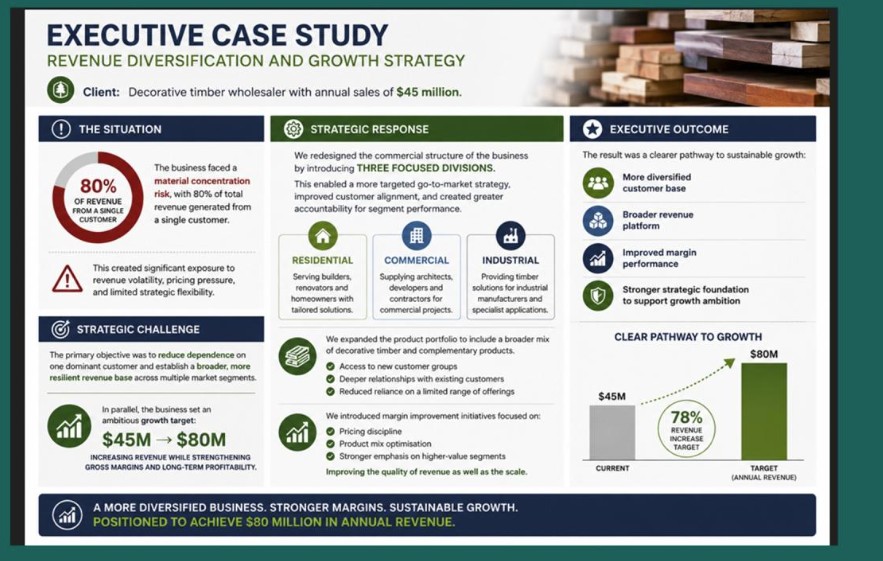
A decorative timber wholesaler turning over $45M in annual revenue was facing a serious growth constraint: extreme dependency on a single customer. Through a strategic restructure of its operating model and a deliberate push into diversified market segments, the business built a clear pathway toward $80M in annual revenue, while improving margins and reducing risk along the way.
The situation
On the surface, the business looked solid. Underneath, it was carrying significant structural risk:
- 80% of total revenue came from a single customer
- High customer concentration risk, which created ongoing pricing pressure and instability
- Limited strategic flexibility, because so much of the business’s direction depended on one relationship
- Exposure to sudden demand or contract changes that could hit revenue overnight
For any Australian business owner, this is the nightmare scenario — one phone call from a single client could reshape the entire P&L. It created an urgent need to stabilise revenue and reduce reliance on a single source.
The strategic challenge
The core objective was straightforward to state, if not to execute:
- Reduce dependency on one dominant customer
- Build a broader, more resilient revenue base
- Improve long-term profitability and strategic agility
- Enable scalable growth beyond the constraints of the existing model
The business also set a clear, ambitious target: grow from $45M to $80M in annual revenue.
The strategic response
The transformation centred on a full redesign of the commercial structure, built around three key moves.
1. Creating three focused divisions
The business was reorganised into:
- Residential division: serving builders, renovators and homeowners with tailored timber solutions
- Commercial division: supplying architects, developers and contractors for commercial projects
- Industrial division: providing specialist timber solutions for manufacturers and industrial applications
This gave each part of the business sharper market focus and much clearer accountability, instead of one undifferentiated sales effort trying to serve everyone at once.
2. Expanding the product and customer base
To reduce dependency on a narrow product mix, the business:
- Introduced complementary timber and product categories
- Opened up new customer segments it hadn’t previously targeted
- Deepened relationships with existing clients beyond the dominant account
- Reduced reliance on a small number of high-risk accounts
3. Driving margin improvement
Alongside diversification, operational changes were introduced to strengthen profitability:
- Tighter pricing discipline and improved commercial controls
- An optimised product mix, shifting toward higher-value segments
- A sharper focus on higher-margin customer relationships, rather than chasing volume for its own sake
The outcome
The transformation delivered a stronger, more balanced business:
- A diversified customer base, significantly reducing concentration risk
- A broader revenue platform, enabling growth across multiple segments rather than one
- Improved margin performance through strategic pricing and mix optimisation
- A stronger organisational structure aligned with the business’s growth ambitions
A clear pathway to growth
- Current revenue: $45M
- Target revenue: $80M
- Projected growth trajectory: 78%
The business is now positioned for scalable, resilient expansion, backed by diversified revenue streams and much sharper strategic focus.
The takeaway for Australian business owners
Revenue concentration is one of the most common and most dangerous risks sitting quietly inside otherwise successful SMEs and mid-market businesses across Australia. It’s easy to let one big client become the centre of gravity for the whole business, especially when they’re reliable and easy to work with.
But that reliability comes at a cost: reduced pricing power, limited strategic flexibility, and a business that’s only ever one contract renewal away from a crisis.
This case shows that the fix isn’t just “find more customers.” It’s a structural one reorganising the business around clear divisions, deliberately broadening the product and customer base, and tightening margin discipline at the same time. Done properly, diversification doesn’t just reduce risk. It becomes the engine for the next stage of growth.